ECON 0150 | Economic Data Analysis
Part 5.4 | Causation, Controls, and Model Selection
Today’s Class
- Why controls matter: causation vs. correlation
- How to compare models: R² and the F-test
- How to choose a model: the model selection framework
Ice Cream Sales and Drowning Deaths
![]()
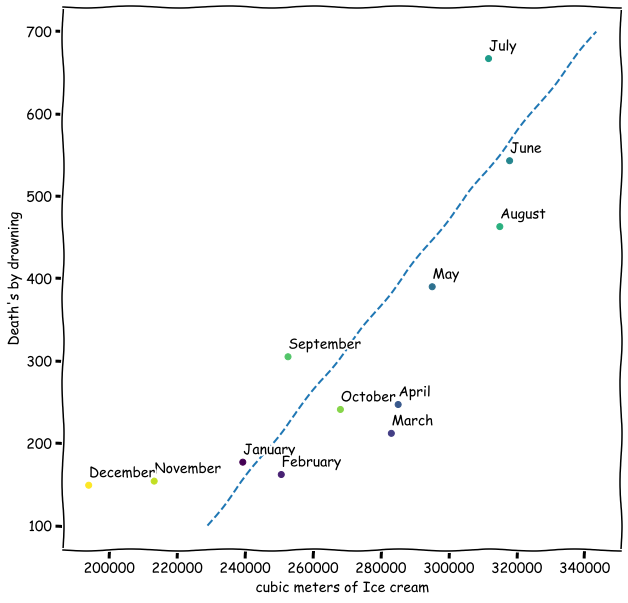
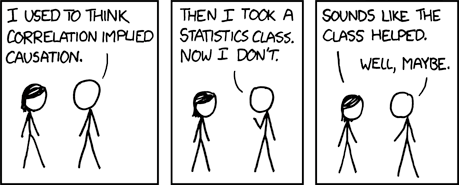
As ice cream sales go up, so do drowning deaths (\(\hat\beta_1\) = 3.4, p < 0.001)!
Q. So ice cream causes drowning?
Three Possible Explanations
- Direct Causation: Ice Cream → Swimming → Drowning
Eating ice cream makes people want to swim?
- Reverse Causation: Drowning → Ice Cream Sales
News of drownings drives sympathy ice cream consumption?
- Confounding: Something else causes both
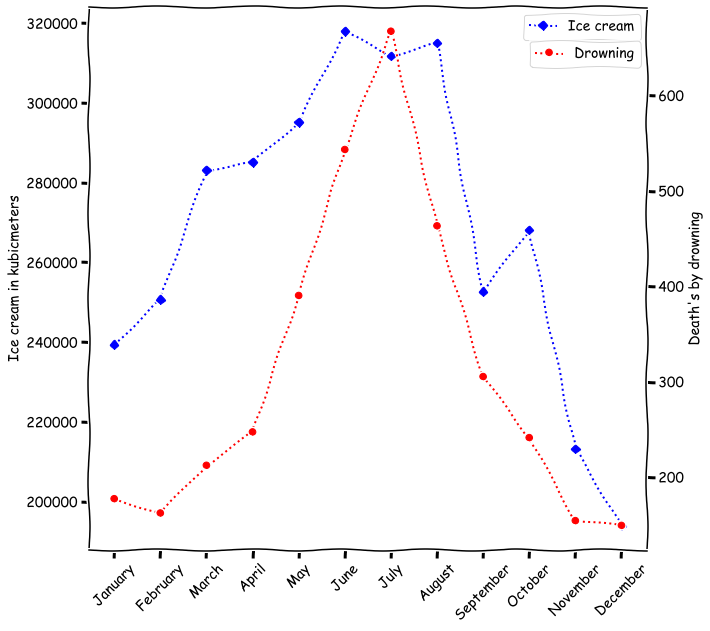
Let’s Look at the Timing
![]()
Both ice cream sales and drowning deaths peak in summer months
The True Relationship
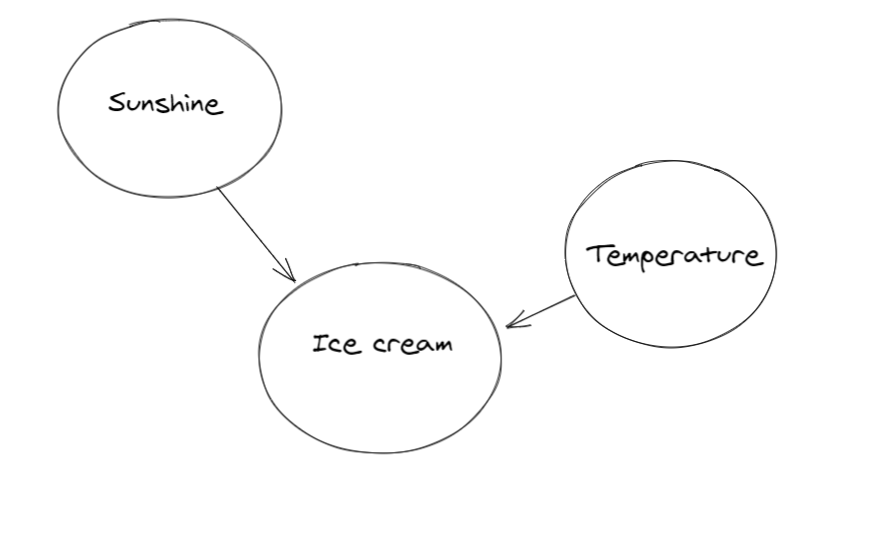
The relationship between ice cream and drowning is spurious.
The Fix: Control Variables
Simple model (spurious relationship):
\[\text{Drownings} = \beta_0 + \beta_1 \cdot \text{IceCream} + \varepsilon\]
\(\beta_1 > 0\), highly significant
Controlled model (add the confounder):
\[\text{Drownings} = \beta_0 + \beta_1 \cdot \text{IceCream} + \beta_2 \cdot \text{Temperature} + \varepsilon\]
\(\beta_1\) becomes insignificant, \(\beta_2\) captures the real effect
This Is What The Homework Has Been Doing :)
| HW 4.1 |
BMI ~ unemployment_rate |
Nothing |
| HW 5.1 |
BMI ~ unemployment_rate + Female |
Gender |
| HW 5.2 |
BMI ~ unemployment_rate × Female |
Gender × effect |
| HW 5.3 |
BMI ~ unemployment_rate + Female + AGE + College + Married |
Multiple |
Each control removes a confounder from the unemployment-BMI relationship.
Controls Don’t Guarantee Causation
1. Omitted variable bias
There might be a confounder we didn’t think of (diet, exercise, genetics…)
2. Reverse causality
Maybe poor health causes unemployment, not the other way around
3. Measurement error
BMI in BRFSS is self-reported, so systematic misreporting could bias results
Controls help, but they can’t prove causation on their own.
Model Comparison
We need tools to compare models:
- R²: How much variation does the model explain?
- F-test: Is the improvement statistically significant?
R²: Proportion of Variation Explained
\[R^2 = 1 - \frac{SSE}{SST}\]
- \(SST\): total variation (SSE of the mean-only model)
- \(SSE\): leftover variation after fitting the model
\(R^2\) measures how much of the variability in the data is captured by the model.
- \(R^2 = 0\): model does no better than the mean
- \(R^2 = 1\): model predicts perfectly
Q. Is a higher \(R^2\) always better?
The Problem with R²: Overfitting
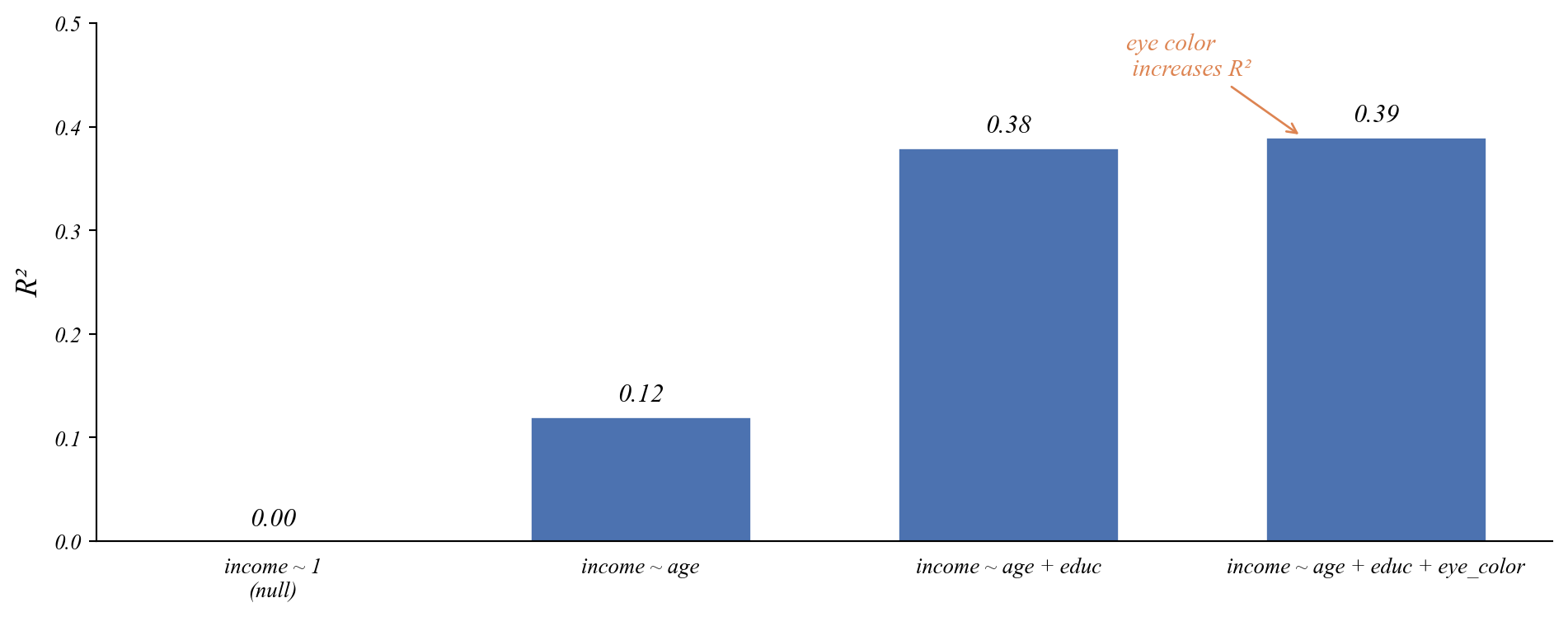
Q. Which of these three models of income do you think is best?
The Problem with R²: Overfitting
Q. Which of these three models of income do you think is best?
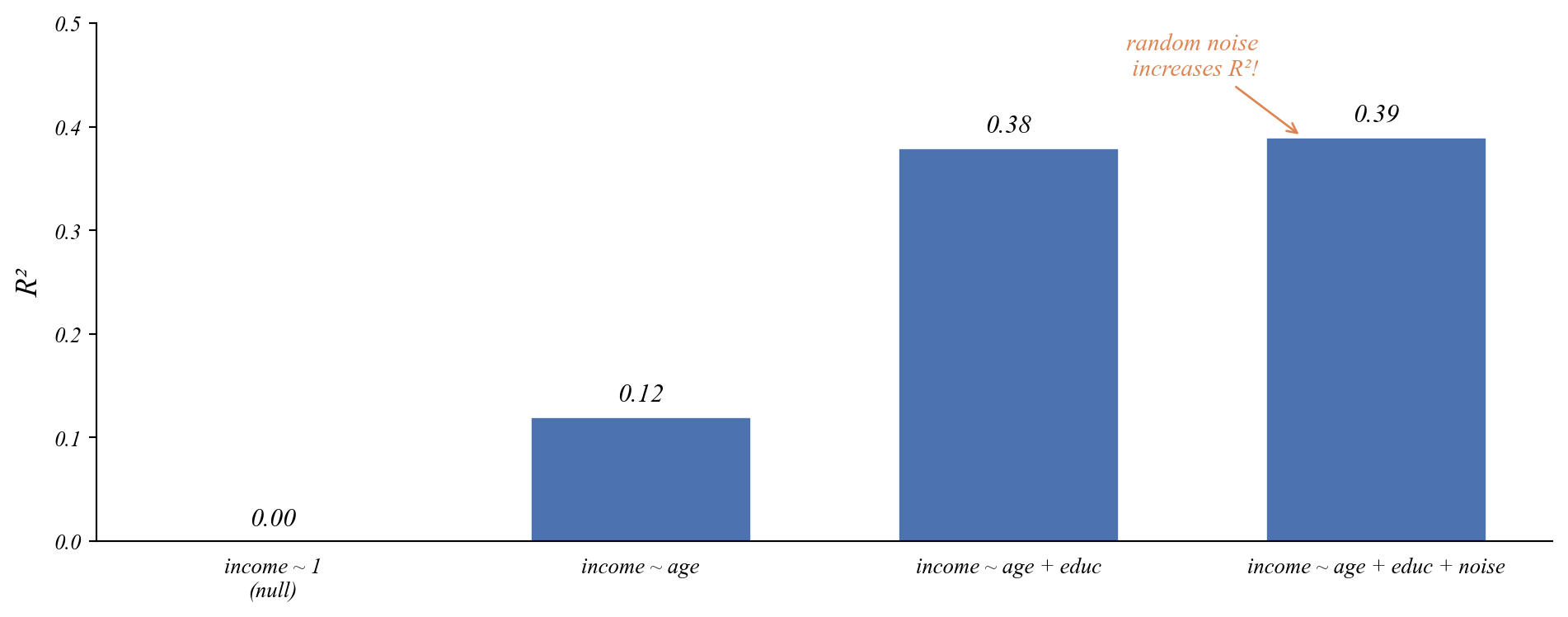
- Adding random noise will improve \(R^2\) a little.
- Overfitting: the model is fitting the noise, not the signal.
- How do we know if the improvement is due to noise?
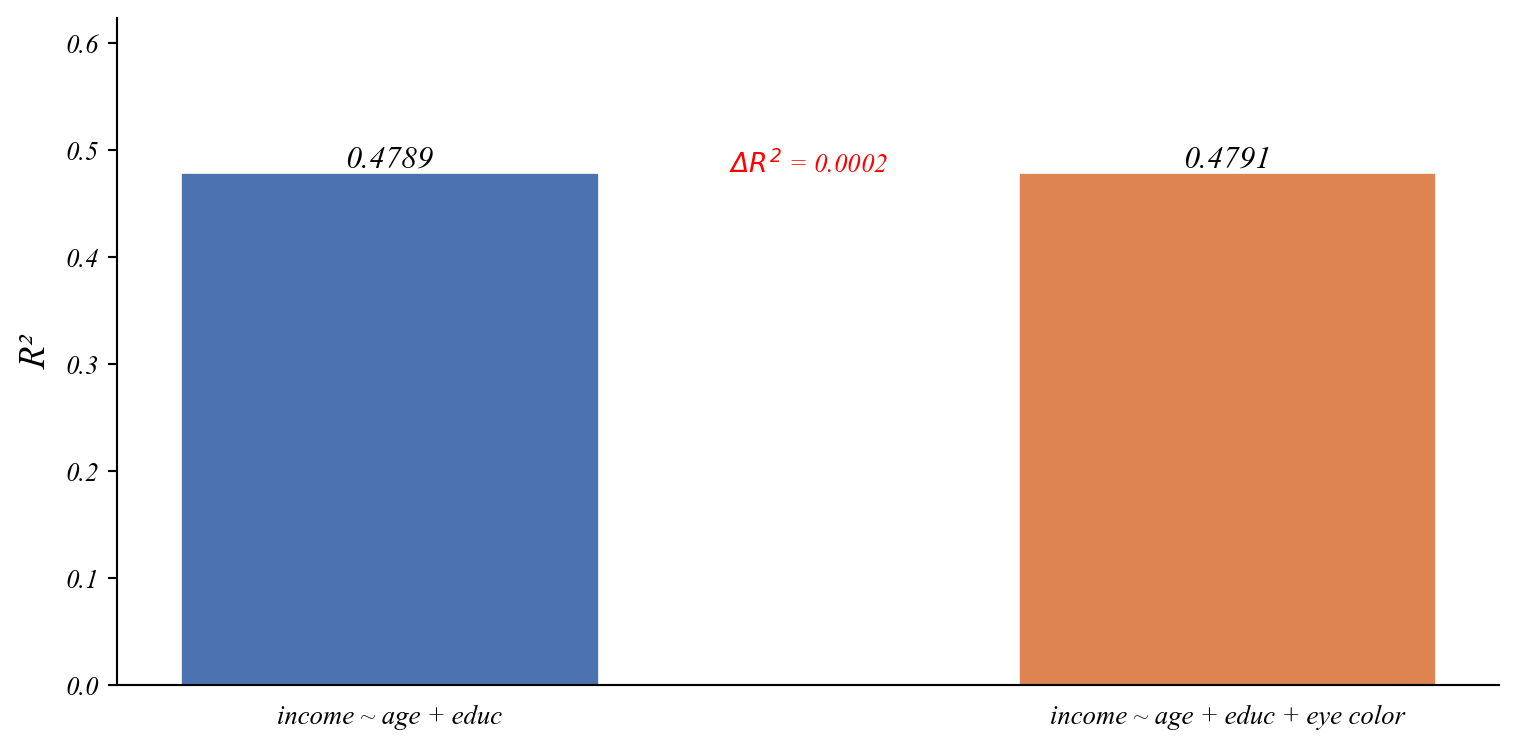
What happens when we add noise?
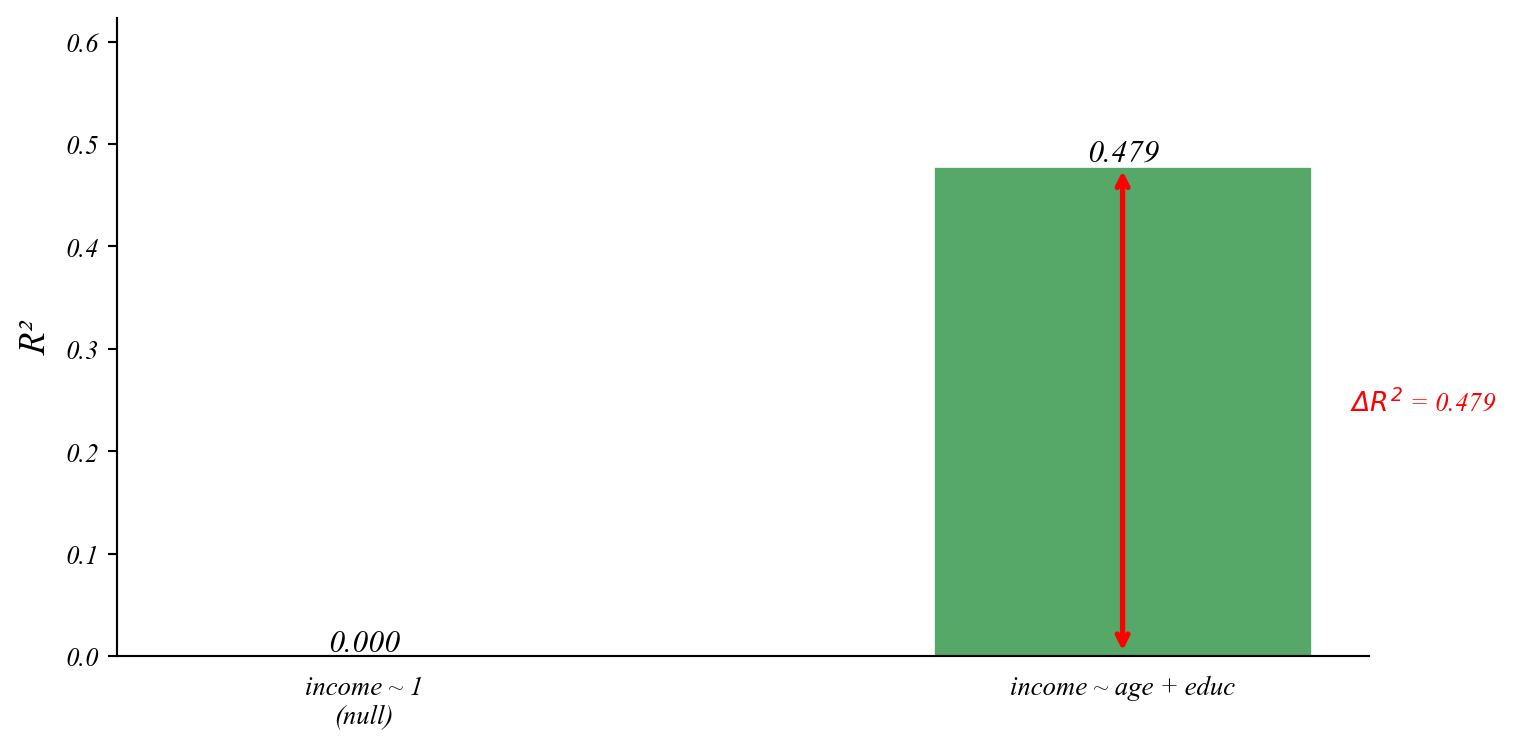
Every time we add noise, R² goes up a little. But only a little.
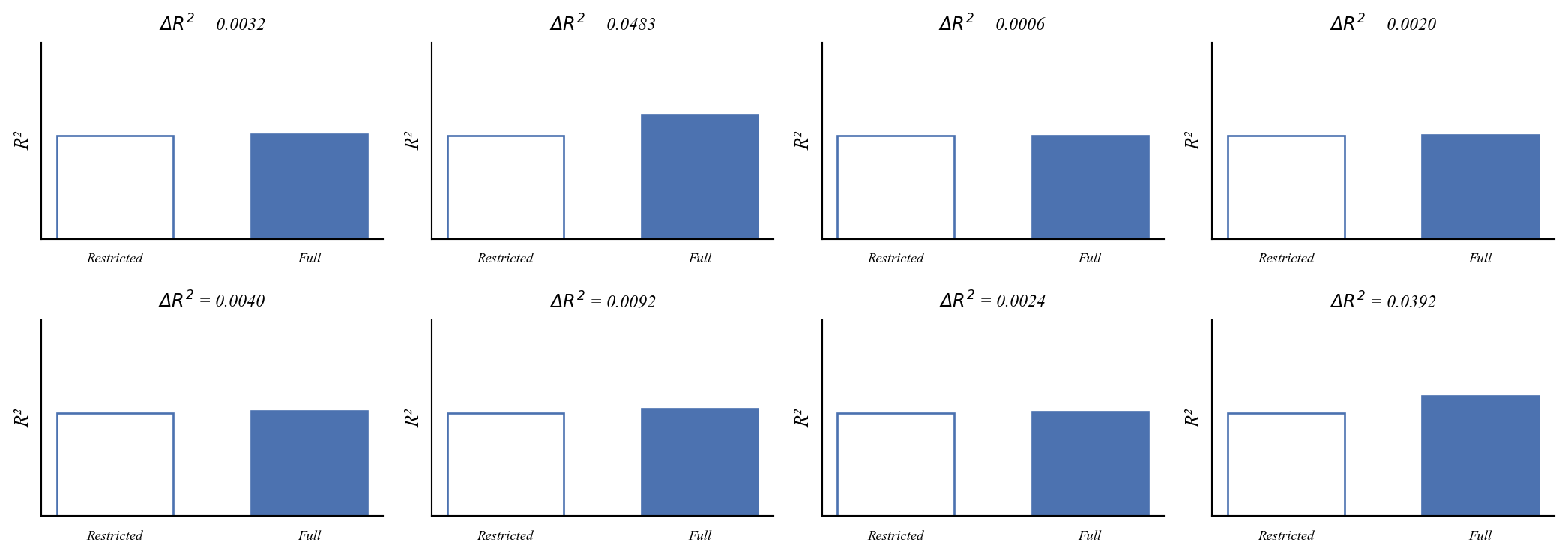
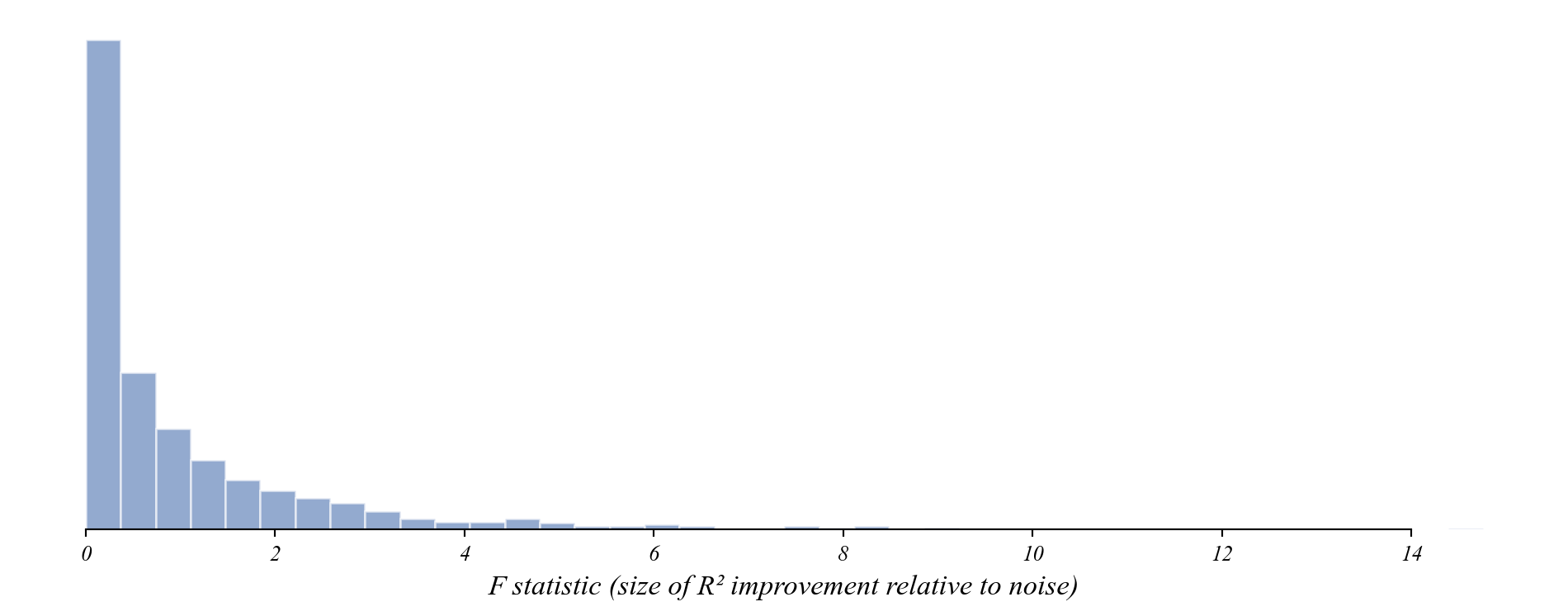
What happens when we do this 1,000 times?
Most improvements are tiny. Large improvements from noise are rare.
The F-statistic
\[F = \frac{(R^2_F - R^2_R) / k}{(1 - R^2_F) / (n - p)}\]
- \(R^2_R\): R² of the restricted model (fewer variables)
- \(R^2_F\): R² of the full model (more variables)
- \(k\): number of variables added
- \(n - p\): remaining degrees of freedom
Numerator: average R² gain per variable.
Denominator: average unexplained variation.
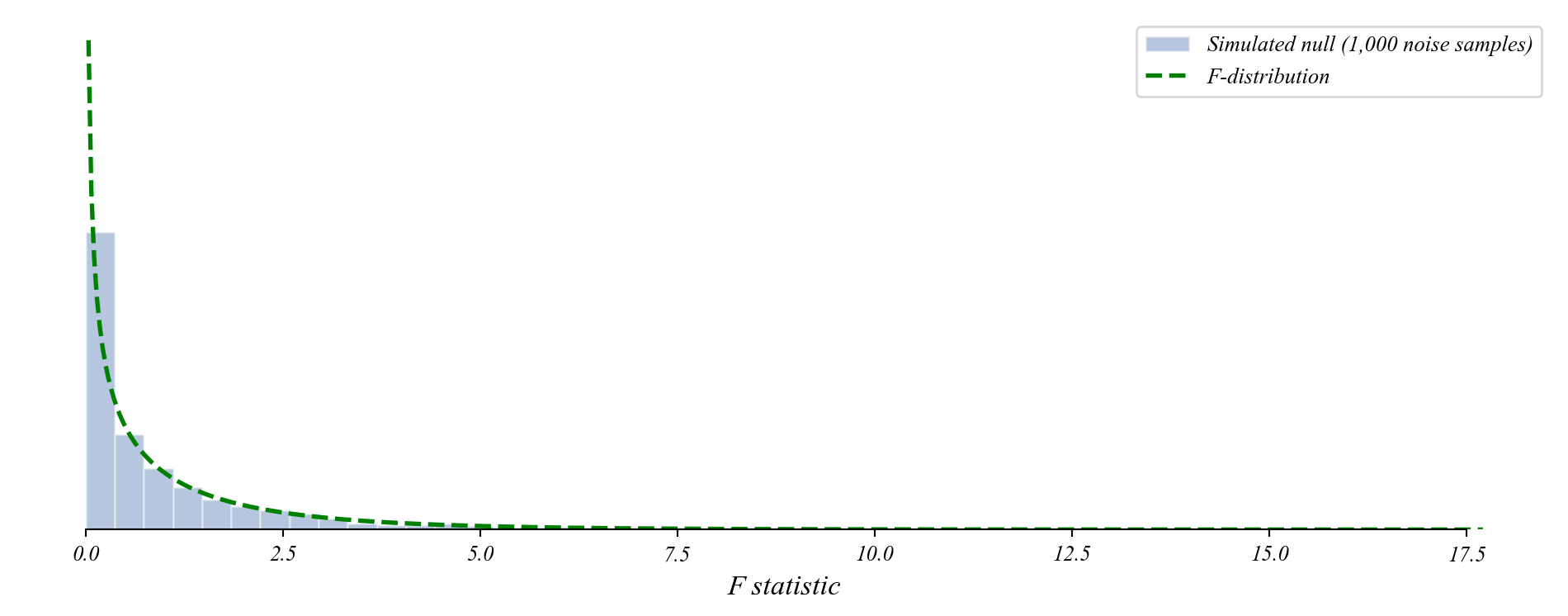
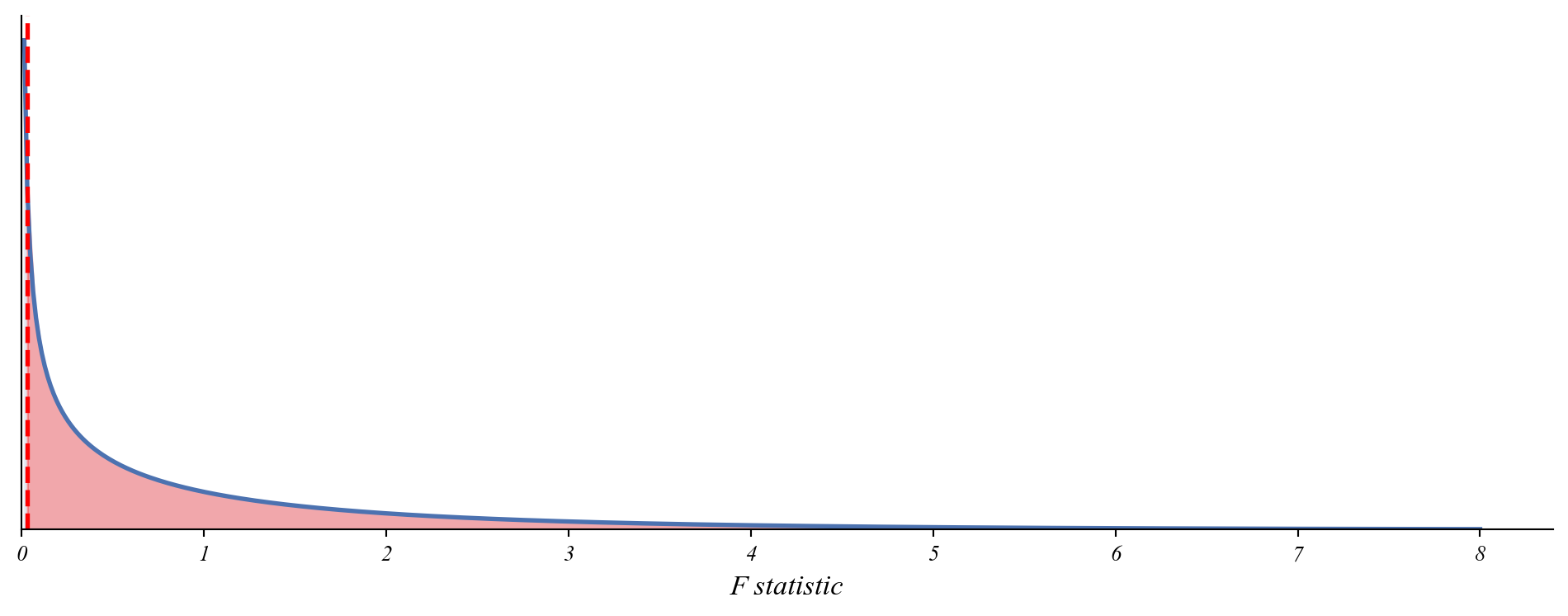
The F-distribution
- The t-distribution described sampling variation in slopes.
- The F-distribution describes sampling variation in R² improvements.
Testing Noise
R² went up. But is this improvement real?
Testing Noise
F-statistic: 0.03
p-value: 0.857
Large p-value. The improvement is just overfitting.
Testing Noise
F-statistic: 0.03
p-value: 0.857
Large p-value. The improvement is just overfitting.
We could also check the t-test on the noise coefficient:
==============================================================================
                 coef    std err          t      P>|t|      [0.025      0.975]
------------------------------------------------------------------------------
Intercept      6.8949      4.274      1.613      0.110      -1.590      15.380
age            0.2350      0.063      3.737      0.000       0.110       0.360
educ           1.9802      0.227      8.723      0.000       1.530       2.431
noise          0.1417      0.785      0.180      0.857      -1.417       1.701
==============================================================================
Both the t-test and the F-test agree: noise doesn’t help.
But what about multiple variables?
The t-test checks one coefficient at a time. It can tell us:
- Does age matter? (test \(\beta_1\))
- Does education matter? (test \(\beta_2\))
But it can’t tell us: do age and education together improve the model?
Testing the Full Model
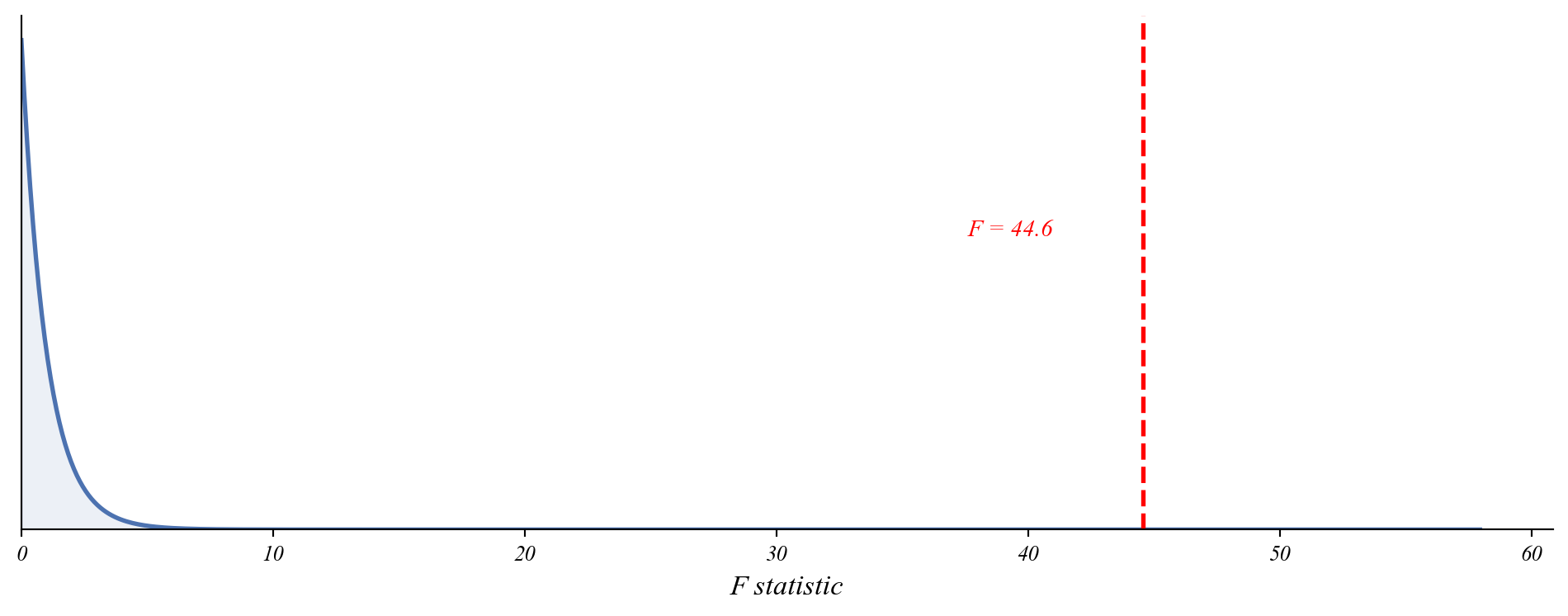
F-statistic: 44.58
p-value: 0.000000
Age and education together significantly improve the model.
Model Selection Framework
| Change in single group |
\(y = \beta_0 + \varepsilon\) (One-sample t-test) |
| Differences between groups |
\(y = \beta_0 + \beta_1 Group + \varepsilon\) (Two-sample t-test) |
| Relationship between vars |
\(y = \beta_0 + \beta_1 x + \varepsilon\) (Simple regression) |
| Multiple factors |
\(y = \beta_0 + \beta_1 x_1 + \beta_2 x_2 + \varepsilon\) (Multiple reg) |
| Group-specific relationships |
\(y = \beta_0 + \beta_1 x + \beta_2 Group + \beta_3 x \times Group + \varepsilon\)
(Interactions) |
| Temporal patterns |
\(y_t = \beta_0 + \beta_1 t + \beta_2 Season + \varepsilon_t\)
(Time series with fixed effects) |
| Many more! |
(You can construct your own) |
Practice: Which Model?
(a) Did average household income change after a new factory opened?
\[\text{income_change} = \beta_0 + \varepsilon\]
(b) Does the effect of study hours on GPA differ for STEM vs. non-STEM majors?
\[\text{GPA} = \beta_0 + \beta_1 \text{hours} + \beta_2 \text{STEM} + \beta_3 \text{hours} \times \text{STEM} + \varepsilon\]
(c) Is there a relationship between commute time and job satisfaction, controlling for salary?
\[\text{satisfaction} = \beta_0 + \beta_1 \text{commute} + \beta_2 \text{salary} + \varepsilon\]
Summary
- Start with the question — What is the causal story? What confounders exist?
- Visualize — Patterns reveal what model to use
- Choose the right model — Match the question to the framework
- Add controls — Remove potential confounders
- Compare models — Use R² and F-tests to evaluate
- Interpret with caution — Controls help, but don’t prove causation