ECON 0150 | Economic Data Analysis
The economist’s data analysis skillset.
Part 5.2 | Interaction Models
Model 3: Different Returns to Education
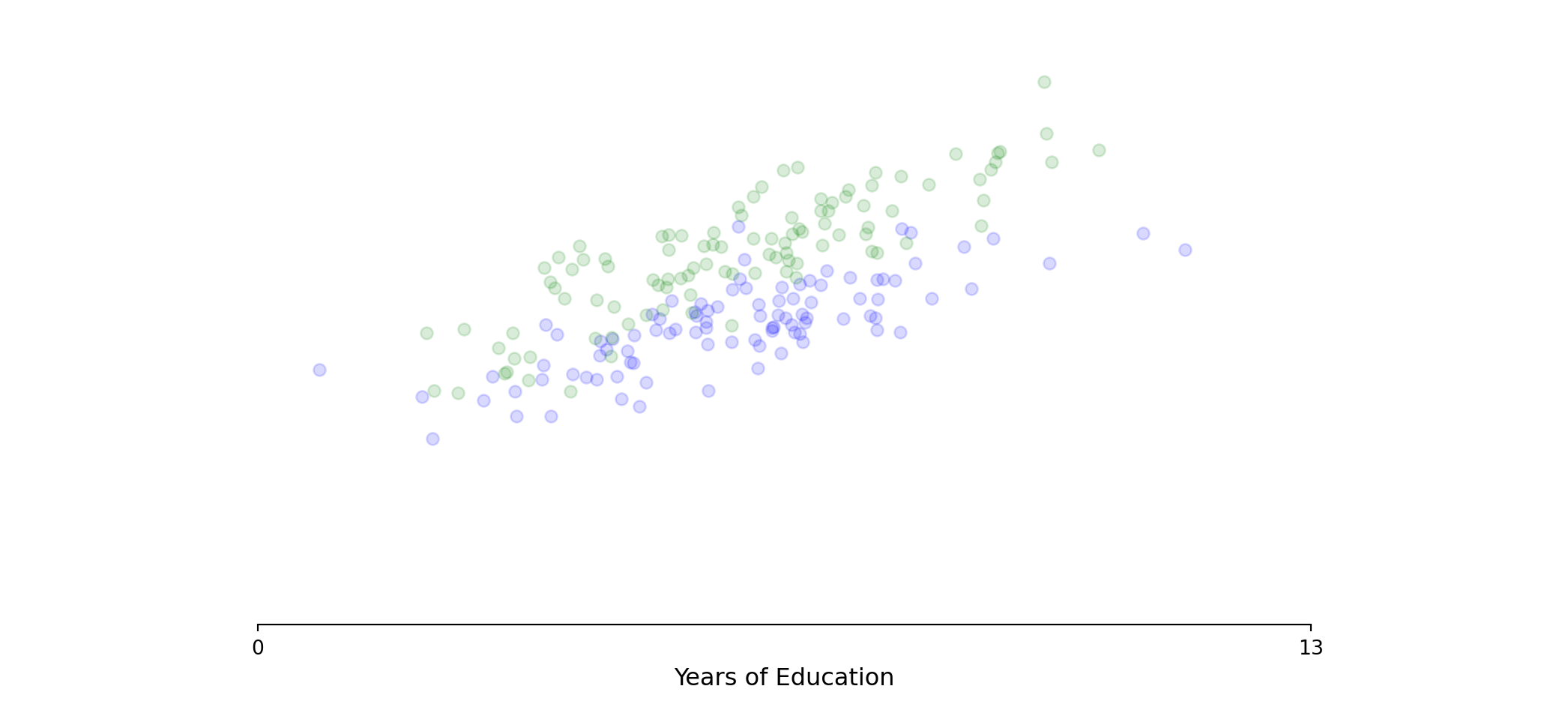
What if education benefits genders differently?
Model 3: Different Returns to Education
What if education benefits genders differently?
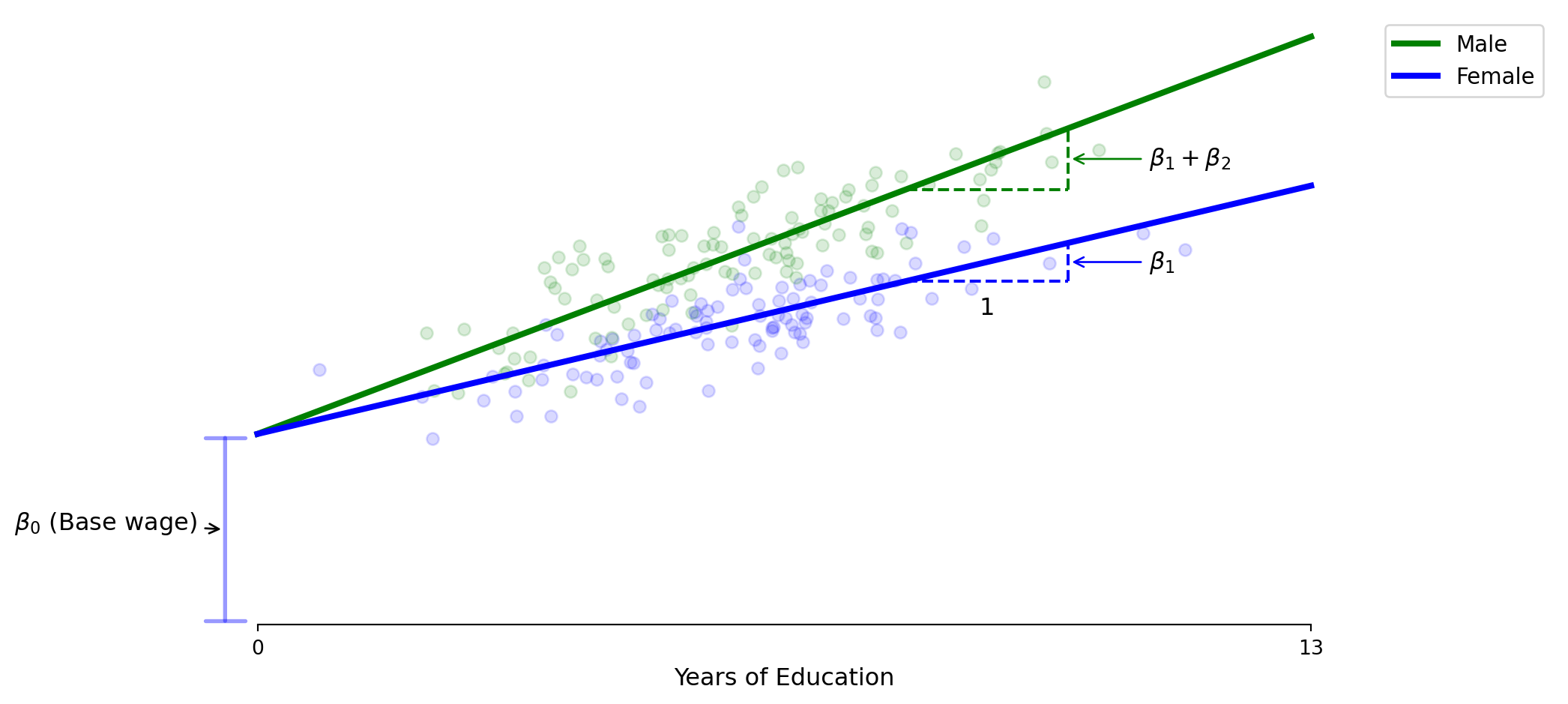
\[\text{Wage} = \beta_0 + \beta_1 \times \text{Education} + \beta_2 \times \text{Education} \times \text{Male} + \varepsilon\]
Model 3: Different Returns to Education
What if education benefits genders differently?
\[\text{Wage} = \beta_0 + \beta_1 \times \text{Education} + \beta_2 \times \text{Education} \times \text{Male} + \varepsilon\]
- β₁ represents the female return to education.
- β₂ represents the additional male return to education (an additional slope)
- Male education effect is β₁ + β₂, creating diverging wage paths
Model 3: The Code
Implementing the education-gender interaction model
# Fit model with interaction between education and sex
model3 = smf.ols('LNINC ~ EDU + EDU:MALE', data=data).fit()
print(model3.summary().tables[1])- If β₂ > 0 and significant, male return to education is higher
- This model assumes same baseline (intercept) for both genders
Why log income?
A $5,000 raise means different things to different people
- If income is $25,000, that’s a 20% raise
- If income is $200,000, that’s a 2.5% raise
Economists almost always use \(\ln(\text{Income})\) since it puts everyone on the same percentage scale.
Interpreting Log Income
What does log do to our coefficients?
\[\ln(\text{Income}) = \beta_0 + \beta_1 \times \text{Education} + \beta_2 \times \text{Education} \times \text{Male} + \varepsilon\]
With \(\ln(Y)\), we interpret coefficients as percent changes.
- If \(\beta_1 = 0.08\), income is 8% higher with one more year of education.
- If \(\beta_2 = 0.03\), men get an additional 3% per year of education.
Model 4: Full Gender Difference Model
Combining fixed effects and interactions
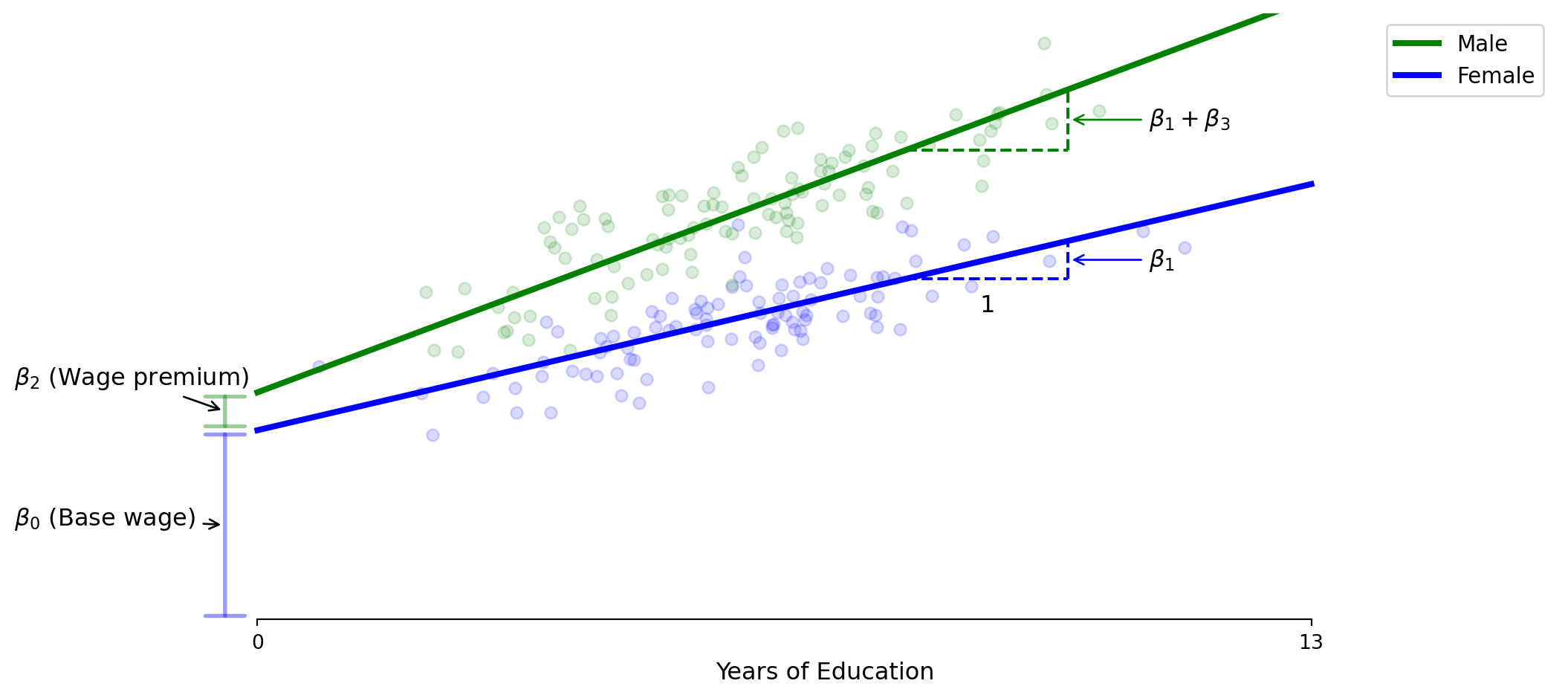
\[\text{Wage} = \beta_0 + \beta_1 \times \text{Education} + \beta_2 \times \text{Male} + \beta_3 \times \text{Education} \times \text{Male} + \varepsilon\]
Model 4: Full Gender Difference Model
Combining fixed effects and interactions
\[\text{Wage} = \beta_0 + \beta_1 \times \text{Education} + \beta_2 \times \text{Male} + \beta_3 \times \text{Education} \times \text{Male} + \varepsilon\]
- β₀ = base wage
- β₂ = initial wage gap (at zero education)
- β₁ = female returns to education
- β₃ = male education return premium
Model 4: The Code
Implementing the full gender difference model
# Fit full model with both sex indicator and interaction
model4 = smf.ols('LNINC ~ EDU + MALE + EDU:MALE', data=data).fit()
print(model4.summary().tables[1])
> allows for differences in both baseline wages and educational returns
Comparison of Models
Different models answer different questions
Model 1: Fixed Effect
- Question: “Is there a gender wage gap?”
Model 2: Fixed Effect with Control
- Question: “Is there a gender wage gap controling for education?”
Model 3: Interaction Only
- Question: “Are there differences in returns to education?”
Model 4: Fixed Effect and Interaction
- Question: “Does the gender wage gap vary with education level?”
Key Takeaways
General linear model for analyzing group differences
Part 5.1 | Categorical Controls (‘Fixed Effects’)
- Captures level differences between groups
Part 5.2 | Interactions
- Capture differences in slopes
Model Choice should be guided by your research question